If your job is fine, just keep doing it for now. If it is a dumpster fire, leave it. In either case, consider a sabbatical or DIY sabbatical to increase the speed of your crowbar phase.
Time Freedom = Savings / Cost of Living. It’s the ratio that matters. If your ratio is 1, you have one year of time freedom. If your ratio is 1/12, you are living paycheck to paycheck. If your ratio is 25-33 and your savings are invested, you probably don’t need to earn any more ever.
The Crowbar Protocol is primarily about decreasing the denominator, that is, decreasing your Cost of Living (COL) while maintaining or improving your quality of life. Most people have a lot of waste in the denominator because the game is rigged against us in various ways (see Beyond #antiwork below), and so can increase the Freedom Ratio faster by playing a different game and focusing on decreasing COL.
Of course, the more money you earn, the more Savings you can accrue, all else being equal. Increasing income isn’t the focus of the Crowbar Protocol. Increasing earnings tends to take a significant amount of personal resources (energy, time, potentially money, etc). As such, I don’t advise spending much attention on increasing income during the Crowbar phase. Income will be addressed in more detail in Volume II.
That said, your job situation might require some decision-making during your Crowbar Phase. The goal here is not “how can I maximize earnings?” or “how can I get a really sweet job/gig that is fulfilling and aligned with my values?” because that’s Volume II and III stuff. The north star is “What situation best supports my efforts to execute the Crowbar Protocol over the next 6-18 months?” In other words, you’re trying to maximize available bandwidth you can allocate towards being successful at Crowbaring your life.
The following are my suggestions:
- You should keep your job if it is really fulfilling, or if it’s kinda meh/slightly crap but you don’t have much savings.
- Take a sabbatical (formal or informal) if your job sucks, or if it’s meh but you have savings.
- You could consider going dirtbag if your job sucks or is meh, but you’ve got a bit of savings.
- Treat finding a new job as an emergency top priority if your job sucks and you’re broke. If a job is soul sucking, then that’s sucking energy out of your life that you could otherwise be putting into making your Crowbar Phase a success. So getting out of that situation is a prerequisite to fully entering your Crowbar Phase.
Here’s a diagram:
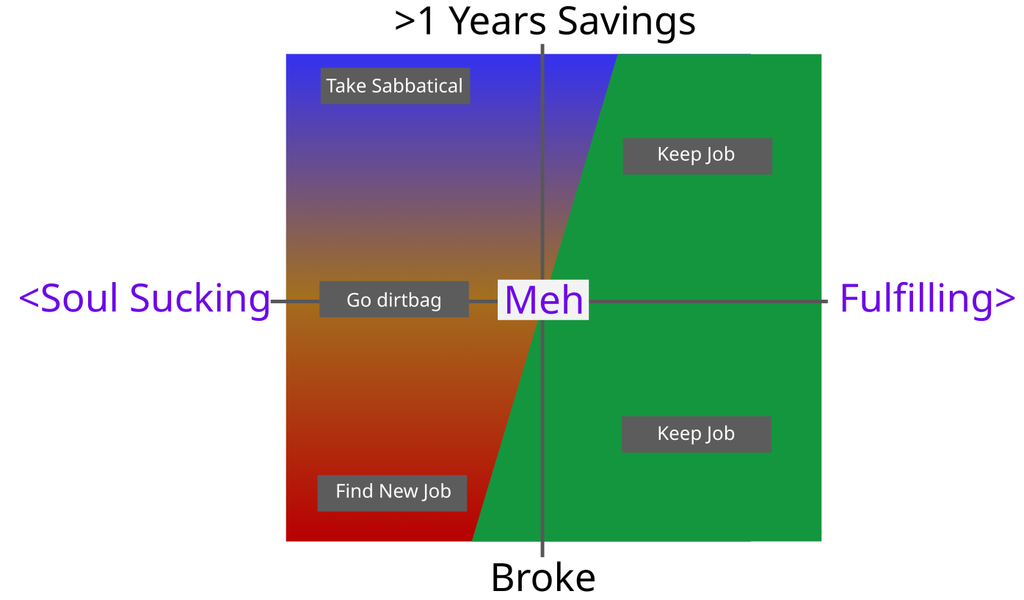
(Going dirtbag in this context just means “make a radical and probably temporary lifestyle change that reduces COL: live in a van, move in with parents/roommates in a cheap place, do worktrade, etc.” The trick is you’ve got to maintain lifestyle agency otherwise you won’t really have freedom to make personal lifestyle changes. Think this one carefully, the risk is that you just have a dirtbag ‘vacation’ and don’t actually learn anything.)
Further Discussion
If your job is just kind of lame because you have to show up on time and you have a boss who tells you what to do sometimes and you don’t super love that, that’s not actually a problem that needs your attention right now. Getting free of the need to show up to a regular boring stressful potentially bullshit etc job is part of the long game we’re playing, and is not an emergency. So just keep on with your job situation for now if it’s only just a bit lame. We’re going to radically change our relationship with “work” and “jobs” and “income” in volumes 2 and 3, but we’ve got to get our Crowbar Protocol phase squared away first.
What I mean by ‘soul-sucking’ is: is it super toxic? are you self medicating because of how awful it is? Is your supervisor or colleagues or customers doing real emotional, psychological, or physiological damage to you? Are you burnt out, depressed, a shallow whimpering husk of your former or potential self? This is an emergency, and I do not recommend trying to crowbar the rest of your life while showing up to a toxic dumpster fire of an employment situation.
I don’t have advice about how to do that beyond obvious platitudes. I know that “just quit and find a less terrible job” is easier said than done. This manual isn’t about how to fix this problem, because I couldn’t possibly do it justice. The move here is to find help that does do this problem justice. (If you go to the ERE forums and start a journal, you will receive a lot of advice from a wide diversity of intelligent, out-of-the-box thinkers from all over the world.)
If you can find the energy required to radically reduce your expenses, then you’ll need the shitty job less, and maybe buy yourself time to quit and find a less shitty job. But that can be a catch-22, I know, if the job is sucking you dry of the internal resources you need to crowbar your life.
One possible strategy here is to save up a few months living expenses (moving up in the diagram) and either negotiate a sabbatical or execute a “DIY sabbatical”, which is where you quit your job and then either rehire at the same place or just get a different job when you run out of money. During the sabbatical you crowbar your cost of living way down. When you go back to work, you have a much clearer idea of what you actually need from employment and you’ll be on better negotiating terms.
Another circumstance you might be in is that, if you’re being honest with yourself, you are just kind of cruising along at a mediocre position with mediocre pay because you’ve been kind of lazy and avoidant about seeking a better position. If you can put in a little bit of effort and get a raise or a better position or take some training to get on a better track, just do it.
Again, this is not to shame people who are in a genuinely terrible situation or dealing with legitimate internal or external barriers to advancement (neurodivergence and prejudice being the top two examples that come to mind). The long game solution I’m suggesting here when it comes to internal or external barriers is to crowbar your cost of living way down (this volume), develop broad stoke-directed skills that build resilience and usefulness (the next volume), and tie everything in your life together with systems thinking (the third volume), which will result in living life on your own terms, terms that play to your unique strengths and desires and doesn’t require the permission or accommodation of an insane and dysfunctional world system.
Beyond #antiwork
One piece of advice I’ll give to anyone, regardless of how much their job sucks, is to move through and past the #antiwork ruminative attitude that the billionaire capitalists are exploiting us and make it structurally impossible for anyone to have a good life.
Look, yes, the system is designed to make it impossible to win. But it’s designed to make it impossible to win at the game the system convinces us is the only game worth playing, which, surprise surprise, is rigged. That game is also lame, so you shouldn’t want to win it anyway! That game requires hordes of the world’s best and brightest humans to engage in relentless propaganda to convince you that the game is worth playing, and to convince you that all the other possible games are either evil, stupid, or a figment of your imagination. If a game requires that much effort to convince people to play it, that alone should be sufficient reason to do anything else.
Your choices are to
- try to win the rigged game, and lose, because it’s rigged and you weren’t born into the Winner class.
- give up trying to win and complain about how the game is rigged, and lose, because even if it weren’t rigged, you weren’t even trying to win anymore because you’ve accepted your fate as a member of the loser class.
- play a different game, and have a chance of winning.
Spending your cognitive bandwidth on antiwork rumination is a) a waste of time and b) actively harmful because it encourages you to believe that agency is a waste of time. Agency is NOT a waste of time, not if you engage it in service of your own life rather than the shadow world of the game the billionaire capitalists want you to play.
Anyway, if you stick with the path of post-consumerism, then you won’t need a bs job for much longer, because either you’ll be financially independent or you’ll figure out some activities to be engaged in that you really enjoy that also happen to bring in some money. But for right now, I don’t recommend trying to get overly clever with your job situation. You want to be focused on reducing your expenses and clearing out the junk in your life, not trying to YOLO some half baked scheme.
For most stably employed people, the best move for the early crowbar phase is simply to keep on keeping on at work while you radically change the infrastructure of your non-work life and set yourself up for future success on your own terms. We’ll discuss what to do about employment in much greater depth in the following volumes.
Leave a Reply