Most of us are locked into lifestyles that require use to exchange 40+hrs/wk of our lives to stay financially afloat. In order to respond appropriately to an uncertain unfolding future, we need more autonomy than that. I’m not going to spend any time in this volume arguing that ‘more personal autonomy of action’ is a desirable state. (I developed that idea in my first book, Deep Response. For this manual it is taken as a given.)
In this context, we can define “freedom” as “how long it would take you to deplete your savings”. If you have $100,000 and spend $10,000 a year, you have ten years of savings.
Freedom = Savings/Cost of Living
Because of the way society is constructed, many of us have been tricked into habits and circumstances where we spend more money than is necessary to live a wonderful life. (In fact, in a lot of cases, the spending of the money decreases our quality of life.) We’ve been tricked into arranging our affairs in unnecessarily expensive ways, and thinking that any reduction in Spending will result in a reduction in Quality of Life.
We’ve been taught that Quality of Life = Cost of Living (the more you spend, the better your life).
This manual offers an alternative: Quality of life = Cost of Living * Skill of Living [1]. (This is a simplification, but it is useful for now in this form.) This means that you can have the same (or higher!) quality of life even at dramatically lower costs of living.
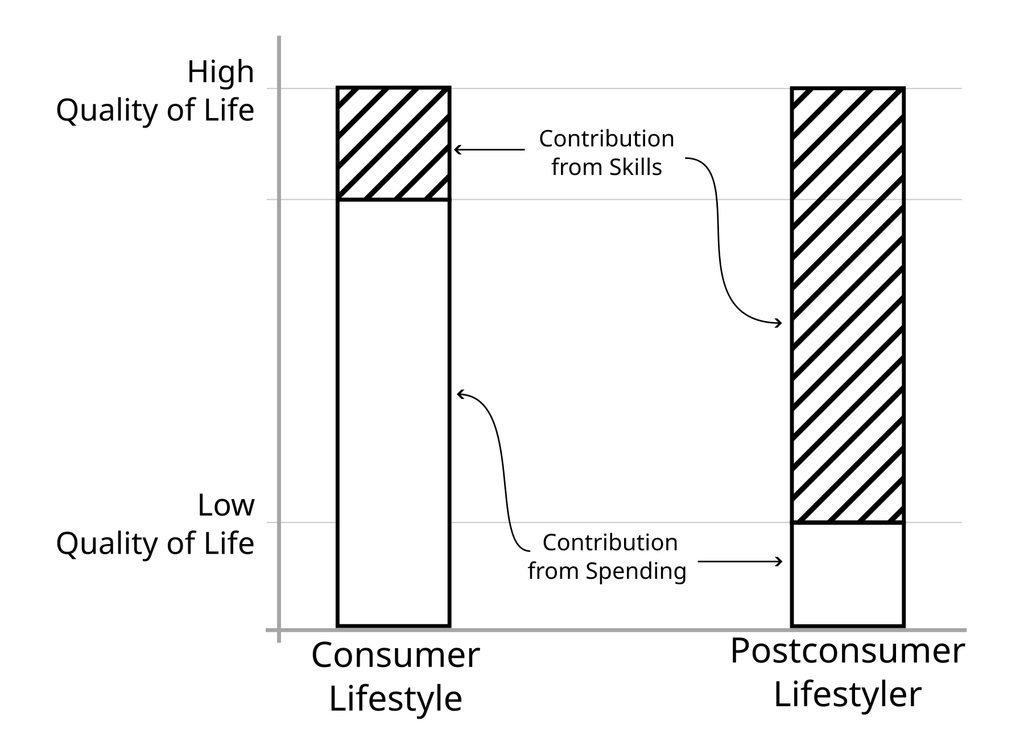
But in fact, this bar chart only tells a small part of the story.
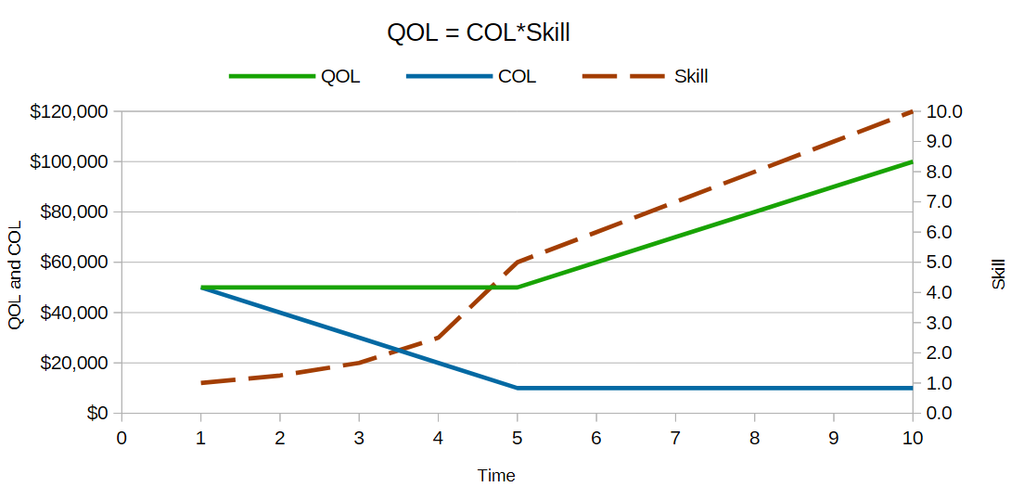
A slightly fuller version of the story is that you can learn skills to decrease cost while maintaining QOL… and then you can keep learning skills, and keep increasing your quality of life, despite having a very low COL. This following graph illustrates using skills to decrease COL, and then using skills to increase QOL. Want a $100k life for $10k?
Even this doesn’t go far enough. There are thresholds, tipping points, accelerations. At a certain point you can buy your time back, which means you can learn skills faster, which means you can unlock even higher qualities of life faster. And claiming that you can get a “$100k Life for $10k” is still framing things in terms of what money can buy, so it’s imaginatively limited. In truth, skills can buy you kinds of life that money cannot. Skills can get you a qualitatively different life, not just quantitatively.
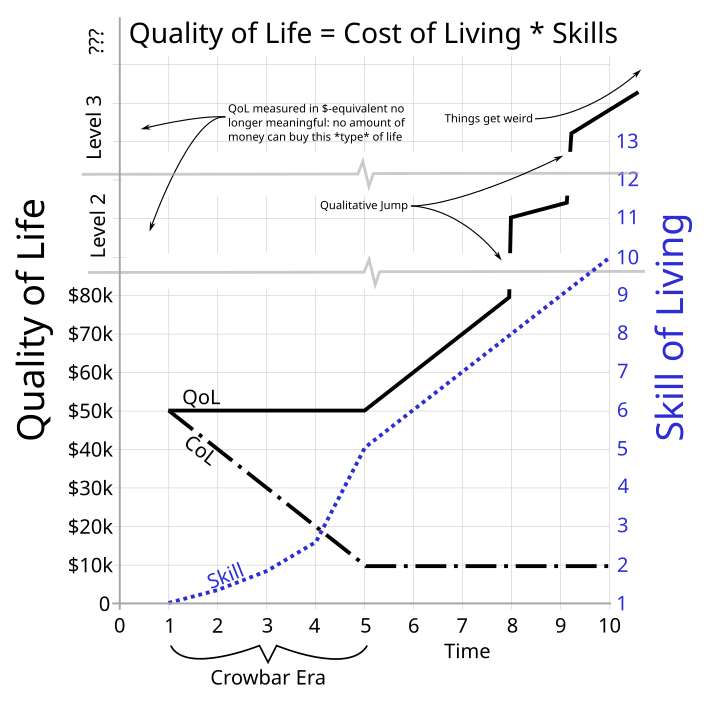
But we’ll return to those higher-order and transcendent dynamics later.
The entire premise of this volume, then, is that we can significantly increase our freedom by reducing our cost of living while maintaining or improving our quality of life via the acquisition and deployment of certain Skills of Living. This is a manual for executing on this premise.
Conceptually, this is an easy thing to do. It is not rocket science.
However, many people find it difficult to execute on this premise and unlock an uncommon level of autonomy for themselves. Why?
In my opinion this work is primarily difficult for emotional and psychological reasons having to do with our relationships with other people, and our identities. And the less naturally frugal of a person you are, the more difficult it is to make these changes in your life.
I am not naturally frugal. I understood conceptually that Freedom = Savings/COL my entire adult life, and I still just blew all my income. I did this mostly because I had emotional and psychological dysfunctions that made reducing my COL emotionally and psychologically difficult. However, I also spent all my money because I lacked awareness of some of the basic skills of low-cost living. I didn’t consciously understand that it was possible to live well on very little money — it was outside of my frame of reference. It didn’t occur to me that it was possible to live well on $10,000 a year. This volume is written for people who, like me, are not naturally frugal and need logistical and emotional frameworks to actually pull off a lower COL in their own lives.
On the logistics and technical skills side of things, this is all fairly straightforward. No higher math is involved, and all of the skills are easily within your abilities. Everything technical in this manual is some variation of “how do I get what I want for less money? How do I decrease COL while maintaining or increasing QOL?” There is learning involved, but it’s mostly just a bit of initial effort, followed repetition to lock in new habits.
What does make the technical aspect challenging is if you choose to go fast. I’m writing this manual from the assumption that you want to do it fast, hence the Crowbar Protocol. The speed is what makes it technically challenging, because you have to learn quickly and recover from mistakes quickly. It can be cognitively overwhelming, particularly if you are balancing work, family life, etc. My recommendation is that you adjust your speed to your cognitive overwhelm threshold. Go as fast as you can, and when it starts to feel like you can’t keep up, dial it back a smidge and lock in. (This is also why you shouldn’t be in
Crowbar Mode for a long time. It can wear you down. Hit it and quit it.)
The Hard Part
Emotionally (psychologically and socially), cranking your COL way down is what is more inherently difficult. Conscious and unconscious status anxiety, peer pressure, misunderstanding and mischaracterization from friends and family, identity issues, overcoming social programming and other internal dilemmas are what make this difficult from a non-technical perspective. The emotionally difficulty tends to be the crux of this process.
The Crowbar Protocol is intended to reduce the emotional pain of this process purely via speed. It’s the rip-the-bandaid-off approach, versus the slowly and agonizingly peeling it off approach. If you go fast enough, people won’t be able to keep up with your rate of change and they’ll be responding to you, rather than having enough time to really entrench and attack you. If you go fast enough, you change a lot of your behaviors which proves to yourself that you are different.
Changing your life across multiple domains is to enter into a liminal state of hypocrisy. Let’s say you start your Crowbar Phase by reducing your food costs. For a month, you focus entirely on reducing your cost of food. You start to build an identity as someone who eats well, but inexpensively.
But you still blow tons of money on housing, and entertainment, and your car, and a hundred other things! What a hypocrite, right? This state is a form of cognitive dissonance. You are building an identity of a wholistically frugal person, but you are not yet wholistically frugal, and you have evidence of this inconsistency everywhere in your life.
This cognitive dissonance is hard to live with, and few people in your life are going to make it easier. The easy solution is to revert to your old behaviors to align with you pre-existing identity.
It is this dynamic which is most difficult to overcome and what causes most failures.
One solution is to go fast. Go as fast as you can. Outrun your old identity, outrun the naysayers and the doubting voices in your head, and build a new identity as quickly as possible. It doesn’t have to be perfect. You can spend time later tidying up the mess you make.
The most important thing is to get as much of your life consistent with your new identity as quickly as possible, and tip the weight of your actions towards proof of your new self. Once you attain this critical threshold things start falling in your favor. The purpose of this manual is to help you get to that point fast.
[1] Jacob Lund Fisker, 2015, https://forum.earlyretirementextreme.com/viewtopic.php?p=99322#p99322
Leave a Reply