Action
When deciding whether to do something or not, draw a reverse fishbone diagram of it.
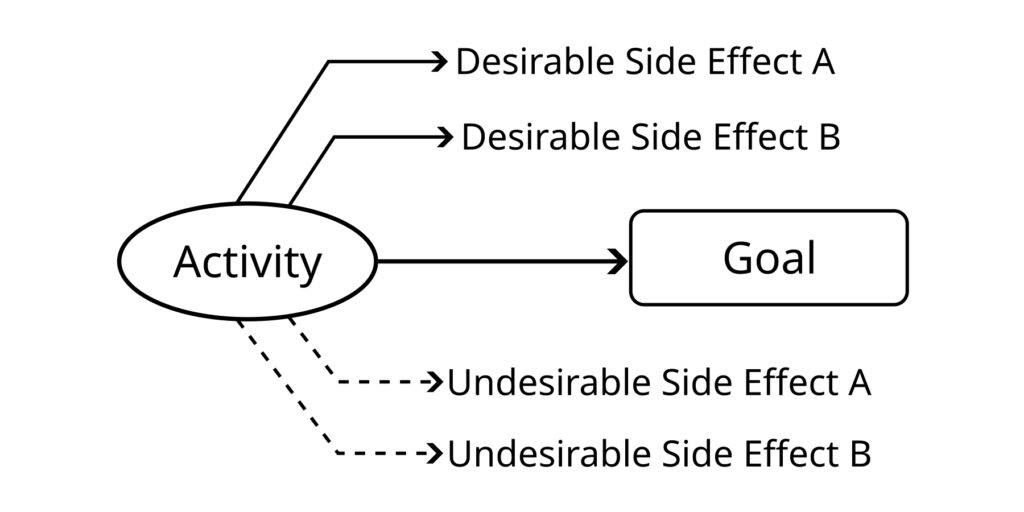
First, write down the action and draw a box around it.
Then, draw the primary Why – the goal, desired outcome, objective, reason, etc for doing the Action – out to the right, and connect the two with a line.
Then, think of what positive side effect might come about as a result of the action, and write these above the line.
For example, if your action is “mountain biking” and the main reason is “fun” or “flow”, some other positive outcomes might be “exercise”, “time with friends”, and “time outdoors.”
Then, think of what possible negative side effects might be involved with the activity. e.g. “need a car”, “fuel”, “spend money on repairs”, and “risk of injury.”

Discussion
The following is lifted directly from my book Deep Response.
“Very few people think clearly about the positive and negative effects of their actions beyond their stated goal. … Mostly people only think about negative effects when they get hit in the face with them, but they might not even realize where it’s coming from. Thinking about these effects ahead of time is rare. If you habituate this way of thinking you are doing better than the vast majority of people out there.
“It’s important to get the hang of this step, of being able to see the positive and negative effects of individual actions. You’ve got to do it enough that it becomes automatic.
“Once thinking through the positive and negative effects of your actions becomes effortless, you want to be able to think about a few behaviors or goals at a time, like we did with mountain biking, climbing, owning a car, and hitchhiking. This starts to happen naturally when you do a lot of analysis on individual nodes, because you lay them all out in front of you and start noticing patterns. At first you’ll notice that it’s just a jumble. The goals and effects don’t have much relationship between them and the overall direction of all of your action-goal-effect nodes is high friction, no overall structure, a bit of a mess.”

“It’s at this stage that you realize how many of your actions are working against each other. It’s a big step in terms of your thinking, because you’ve gone from thinking about actions and goals in isolation to thinking about—or at least noticing—the relationship between your sets of actions and goals. Once you can see this disorganization you can start organizing and aligning your goals so that they at least aren’t pointing in opposite directions and working against each other.

“This step takes longer because it requires you to understand at a high level what you want your life to look like as a whole. The most difficult part of this process is simply understanding what it is you want as a unique individual. You’ve got to begin the process of teasing apart things you genuinely want for yourself and things that you think you want, but are in actuality programming from society, culture, parents, or friends. The reason most people’s lives are a jumble of disconnected goals is because they don’t have a clear and consistent idea of who they are and what they want.
“As you notice this you’ll start to make more aligned decisions about your actions. You’ll get a sense for where you’re trying to go and start trimming actions that don’t move you in that direction, and adopting behaviors that do. Your life as a system will start to look a lot more aligned. This isn’t an overnight process. It’s a lot like gardening.”
References:
- The figures and discussion come mostly from my book Deep Response, Chapter 8, How To Think About Everything At Once, which I think of as the Systems Thinking chapter.
- Chapter 8 of Deep Response draws heavily on Chapter 5 of Early Retirement Extreme, by Jacob Lund Fisker.
Leave a Reply